Applied R&D with a global Tier-1 automotive manufacturer · 2022–2026
Physical AI for Process
You bring the CAD. The geometry is never assumed — the process window is optimised for the part you actually upload.
The industrial problem
A design can be signed off and still fail on the shop floor. The same mould, the same material and the same part will come out inside tolerance or scrapped depending on mould temperature, cooling time, press force and where the charge was laid — and the number of combinations is far larger than anyone can trial physically. So the process window gets set by the most experienced operator on the line, written down nowhere, and rediscovered from scratch at the next plant.
The geometry here is not fixed, and it is not ours. You upload your own CAD file; it is meshed into the graph the network reasons over, and the process window is then optimised for that part rather than for a demo part we chose in advance. Which matters, because the effect of a process change is never local: move the charge at one corner and the material flows differently across the whole component, so the warpage shows up somewhere else entirely. A model that predicts quality point-by-point cannot capture that — it has to reason about the part as a connected whole, which is exactly what a graph network does and a tabular regressor does not.
The system
Why a graph, and not a table
The geometry is not fixed and it is not ours — you upload your own CAD file and it is meshed into exactly this: nodes joined by edges. Below is a car body meshed that way. Strike it anywhere and the impact travels outward one hop per message-passing step, which is how a decision made in one corner of the mould ends up as warpage somewhere else entirely. The process is then optimised for your part, not for a demo part we picked in advance.
Drag to rotate the body. Press any node — the impact is applied there and travels outward one hop per message-passing step, exactly as the network propagates it. The shading that stays behind is the field it leaves on the geometry, which is why a change made at one corner of the part never stays at that corner.
Scroll the figure sideways →
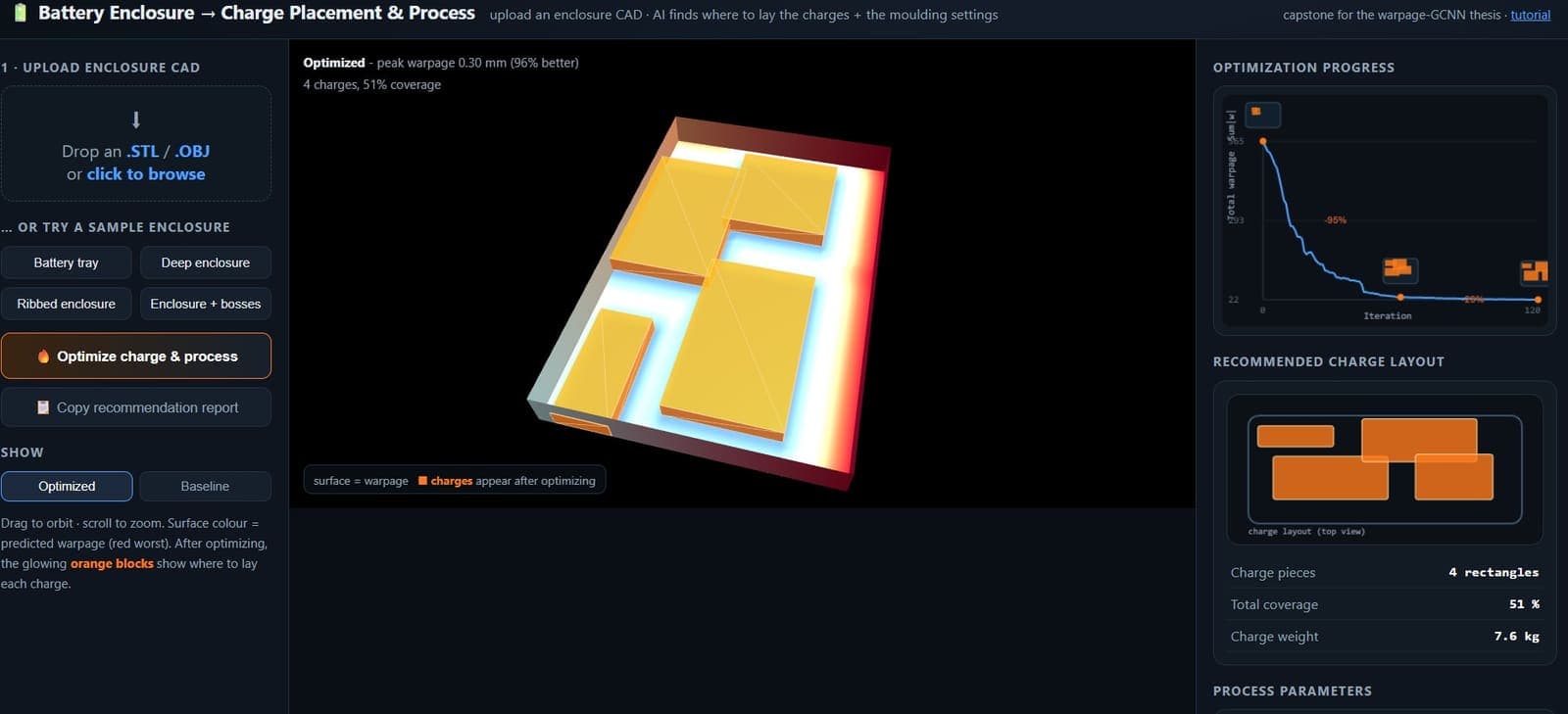
Battery enclosure → charge placement & process window. Upload a CAD file; the surface colour is predicted warpage, the orange blocks are where the optimiser recommends laying each charge, and the panel on the right reports the process parameters that produced it.
Scroll the figure sideways →
In motion
The process search running: predicted warpage driving where each charge is laid and how the press is set.
How it was built
- 01
Your CAD becomes the graph
Upload the part and it is meshed into the model — nothing about the geometry is hard-coded, and the network runs at any mesh resolution rather than at one fixed part. Nodes carry coordinates, zone values and surface area, and the process parameters — mould temperature, cooling time, press force, charge weight — condition every node at once rather than entering as another column. An Encode–Process–Decode graph network then predicts warpage in millimetres per node.
- 02
Let the effect propagate
Each message-passing step moves information one hop along the mesh, so after a handful of steps a change made at one node has reached the entire part. That is the mechanism behind the interactive car mesh below: strike the body anywhere and watch the effect travel node to node across the geometry. The network learns how a local process decision becomes a global quality field, which is the thing an operator knows by feel and cannot write down.
- 03
Search the process window, not the part
The trained network is fast enough to stand in for the solver, so Bayesian optimisation can search the process window directly — thousands of candidate settings evaluated against predicted warpage, returning a recommended charge layout and parameter set together with the convergence curve that justifies it.
What it measured
- 3 parts / 64 datapoints
- Physical trials the validated models were trained on
- ~80% less data
- Required versus conventional data-hungry approaches
Achieved in applied work at a global Tier-1 automotive manufacturer, where the founder established and led the AI team for global OEM projects.
What this builds on
- M.Sc. thesis, Bonn-Aachen International Center for Information Technology (b-it), 2024
- Graph CNN-Based Warpage Forecasting for Improved Quality in Electric Battery Case Manufacturing — industry-side supervision by the founder; supplies the process-conditioned quality prediction and the Bayesian process search.
- Pfaff, Fortunato, Sanchez-Gonzalez & Battaglia, ICLR 2021
- Learning Mesh-Based Simulation with Graph Networks — the encode–process–decode backbone the process model is built on.
Archive: fable5_design_material_process (fable5_platform, fable5_pkd_thesis)